Showing posts with label Gorham. Show all posts

Sunday, November 9, 2025

Wave Camp Report - October 15

 Andy Kozak writes another report:

After two days of overcast and rain it looked like there would be a more classic wave day, perhaps with the potential for Diamond climbs (over 5,000 meters). During our morning safety meeting and weather briefing, winds aloft were forecast to be a little more from the north than would be ideal. The moisture in the air resulted in clouds covering the tops of the Moriah-Carter range. We waited for the clouds to clear above the range so we could at least ridge soar. Some of us topped off our oxygen tanks.

There is a significant amount of organizing and coordinating that occurs before anyone can fly. Tow planes must to be flown to Gorham. Fuel tanks are staged and compressed oxygen tanks brought to fill our onboard systems. It is not much different from typical club activities, where there is much work done behind the scenes.

This morning, our flights had to stay below 9,000 MSL until F35 operations concluded. A call had to be placed to confirm that the airspace up to 18,000 feet was clear and then another call to allow us to fly to 25,000 feet.
 
Rick Roelke and Glen Kelley, two of the more experienced pilots, and wave camp organizers, took off first to get a better look at what the cloud cover behind Mt Washington might look like. Glen would also be towing later. Rick reported the area behind Mountt Washington was clear. I was second in line at that point, but the pilot ahead of me needed to take some more time, so suddenly it was my turn. Jerry Smith had driven up that morning to be one of the towpilots. I  agreed to his suggestion that he would tow me straight into the primary wave behind Mt Washington.

To save time when staging gliders, the pilots strap themselves into their gliders, while still off the side of the runway, allowing the towplanes to land short with their ropes attached. The gliders are then pushed backwards, down onto the runway and turned into position. I made my final control and radio checks while being rolled into position. My tail dolly and wing wheel were removed by the ground crew. I positioned myself as low as possible in the cockpit and pulled straps as tight as I could. I would tighten them again once on tow.

At Gorham, there are not many options in case of a low rope break. I always focus on anticipating the towplane's initial climb and keeping constant tension on the tow rope. I set the flap to position 4 for taking off and towing.  With a total weight of 750 pounds, and assuming a worst case 30/1 lift-to-drag ratio, there should be 25 pounds of force on the tow rope. The slightest impact load from a slack rope will double that load. It would be interesting to know the real statistics of rope breaks.

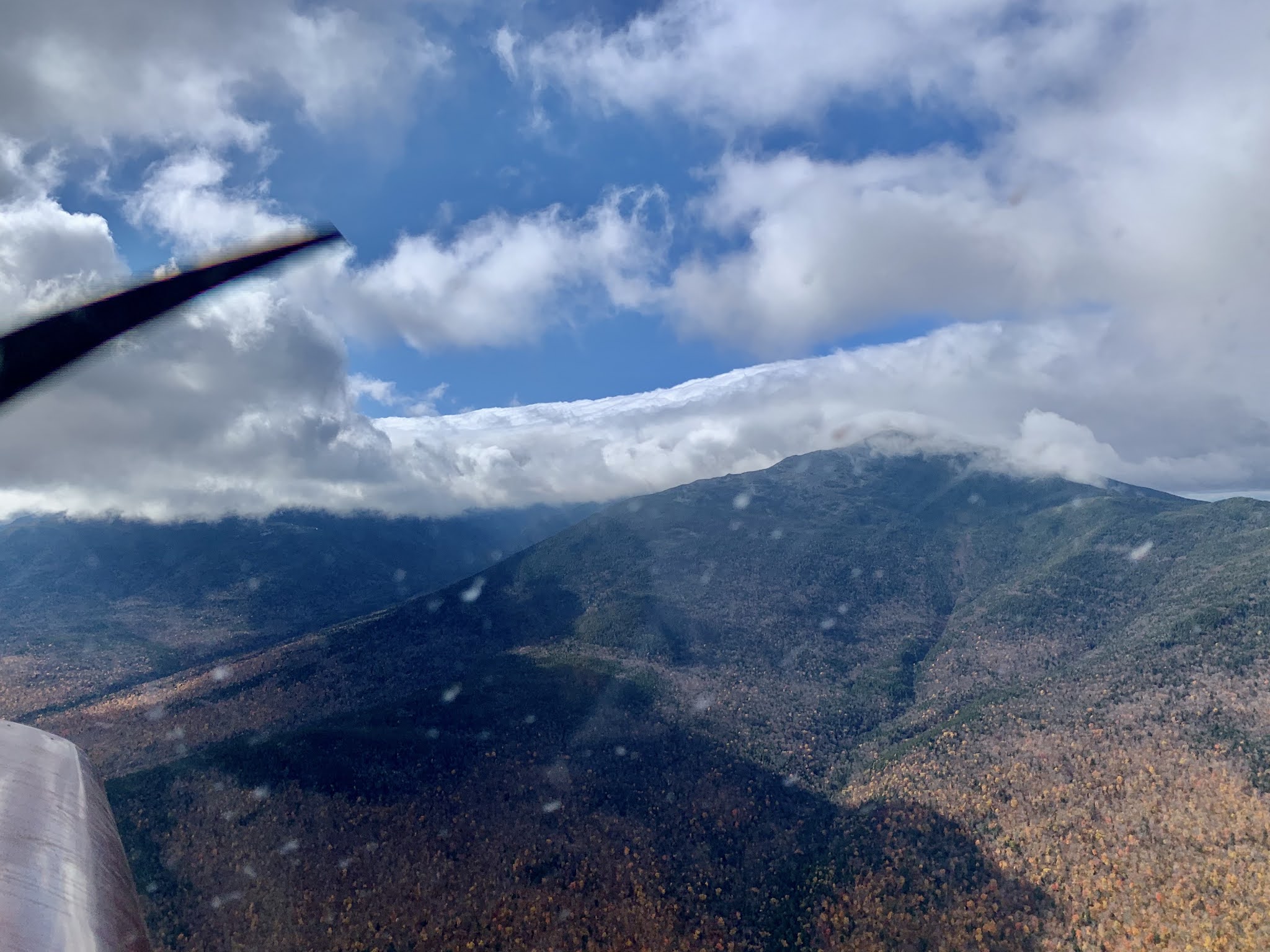
The tow took me past Pine Mountain, which overlooks the airfield and toward the western slopes of Mount Madison. Then over the notch between Madison and Adams. The air was rough, and I distinctly remember my glider making noises that I had never heard before. We flew out over the Great Gulf Wilderness and along the upwind side of a roll cloud, finally turning straight into the wind. The energy in the air near the rotor was impressive. My eyes were locked on the tail of the towplane, while trying to keep an eye on my surroundings with only peripheral vision. The 200-foot rope gives you just under two seconds to anticipate the air you will fly into.  I tried not to overcontrol, potentially leaving me in a poor position for the next upset. I was fairly certain we were in strong lift, but it was still very turbulent. It is always nice to wait for smooth air prior to release. Then the towplane danced in a way that convinced me to pull the release. I thanked Jerry and continued up at a spectacular rate.

The clouds below me were falling away, my variometer needle was pegged, suddenly everything seemed almost perfectly quiet and still. It was surreal. I had to check my air speed indicator to make sure I was flying. Jerry radioed that he was still climbing. My vario finally came off the peg and showed a climb of just under 10 knots. I think I can reset the range so next time it will show up to 20 knots of climb.

Tim Chow told me he likes to tow here because of the challenging conditions. Jerry was headed back down to do it all over again. I am obviously still getting used to flying in these conditions. I cannot express how impressed and grateful I am that the towplane pilots are willing to tow here. The wave appeared to be forming off the Jefferson-Adams-Madison ridgeline, which was in cloud. The wave window was open below me and toward the northeast. Mountt Washington's summit was obscured, though parts of the auto road and the Horn were occasionally visible.  The Horn is a major spur that is marked by a switchback in the auto road. Many years ago, when the road was much narrower, cars would sound their horns when approaching this sharp turn.
 
Downwind of me there was a large area of clear air so I had options for descending.


As the climb rate slowed, I shifted upwind to remain in the strongest lift.  The wind speed did not seem to increase appreciably with altitude, but it did not decrease. Rick Roelke in LT had motored over after trying to climb over Mount Hayes near Gorham. We made sure to communicate our altitude and position while keeping an eye out for each other.

Rick had a passenger with him, Terry Sweeney, a former hang glider pilot. Terry was the first person to hang glide off Mount Washington in the 70’s. He was also the first to land in a tree on Mount Washington, on that same flight. Terry flew in the days of building your own hang glider. Bamboo poles, plastic and duct tape. Now we have carbon fiber, Kevlar and electrical tape.  Rick and Terry flew back toward the Carter Moriah range looking for a better climb in the secondary wave, but had no luck and returned to the primary.

Prior to passing through 18,000 feet I heard we were cleared to 25,000 feet. Approaching 19,000 feet, I could see a lenticular cloud above and the promise of sunshine ahead. 


Although I wore every fleece layer I’d packed, the temperature kept dropping. Rick and I could also see an approaching cloud layer. It became a race, but as my canopy started to frost up on the inside, the cloud on the outside grew thicker. I topped out somewhere around 19,700 feet. The lift at that altitude was widespread so I think we were starting to connect to the lenticular cloud which looked like it would have allowed spectacular altitude gains. However, the reduced visibility due to the approaching cloud, the frosting canopy as well as the possibility of icing on the wings prompted me to announce my descent.  Rick replied that he was already descending as well. 


The wave window would open and close for the rest of the day. Some pilots never had an opportunity to climb above the clouds while at least one managed to reach 22,000 feet. I was fortunate to take off and climb through the window when I did. I flew east toward the Sunday River ski resort in Bethel, Maine. I tried to see if I could locate wave lift based on the shape of the clouds below. At times I could, but I did not stop to climb, since the cold and the limited wave windows were a concern. Turning back, I kept in range several options for descending through the cloud layers. I eventually returned to the area above the Presidential Range and then chose the window over the Wildcat ski area and the Glen House. This is at the intersection of Route 16 and the Mount Washington auto road and would allow an easy glide back to Gorham airfield.
 
The rest of the flight was as uneventful as landing under wave conditions with high winds could be. My approach was much improved over my previous flight, but turbulence seemed to follow me almost all the way to the ground. The next glider to land had the same experience. The winds had been forecast to increase over the day, which was worrisome - but shortly after we landed the winds seemed to moderate and follow up landings seemed almost sedate. It made me feel that perhaps I was not relaxed enough and was overcontrolling. I will work on that next season.

To top off the day, nine of us travelled to dinner at Cho Sun, an excellent Korean restaurant in nearby Bethel.
 
This year’s wave camp ran from October 10-18, and I believe there were only two non-flying days. Orographic wave was present on six of the days with many flights from 12,000 to over 22,000 feet. Strong winds ranging from Northwest to North produced wave and on one day, strong winds from the East also resulted in wave.  The easterly winds produced wave on the west side of the Moriah-Carter range as well as on the west side of Mount Washington.  On that day the wind grew weaker with altitude, eventually causing the Mount Washington primary wave to “break” resulting in severe turbulence and limiting any climb. Wave was also present on lighter wind days. One day had only thermal lift. \

The Mt Washington area is a special place to fly. The scenery is spectacular and the proximity of the Gorham airfield to several ranges provides many options for excellent soaring. A special thanks to all those who continue to make this possible!

Wednesday, October 15, 2025

Wave Camp report - October 12

Andy Kozak writes:
 
Wave camp began this past Friday (October 10) with some nice thermaling weather. This turned into light wave conditions and several pilots took advantage and had altitude gains of 12,000 feet over the fall foliage and stunning terrain of the Presidential Range. Saturday was a light thermal day with no wave. 

Sunday was forecast to have strong easterly winds but with decreasing wind speed with altitude. I drove up Sunday morning and arrived around 10:30. Several pilots had already taken off and more were getting ready to go. After assembling 2R, I joined a group of pilots, one of whom had recently landed. His report was that he had left wave lift to try and reach stronger lift but had experienced very strong sink, forcing him to head back to the airfield.

Reports via radio indicated good climbs and nobody else was returning to the airfield. Gorham airfield has limited staging area so when taking off toward the east only one or two gliders are towed to that end of the field. The towplane pilot came over to brief me on what he had been experiencing and where he had been finding wave. The airfield sits at 835 feet ASL. The first tows had only been to 4-5,000 feet and those pilots experienced severe turbulence in trying to climb into the wave. Among them was Bill Batesole who in recounting said it took him an hour and a half to feel his stomach settle down. Subsequent tows had been to 6,000 feet, between Route 16 and the Carter-Moriah range. Pilots would then climb to approximately 10,000 feet and head downwind to connect to the wave generated from Mount Washington - where there was stronger lift. 

I tightened my belts several times prior to taking off and then again on tow. My oxygen system was already on and would start to provide oxygen at around 10,000 feet. Most of the tow was uneventful. From Gorham the tow takes you south, up the Mount Washington valley. It becomes more spectacular the further you go. I could see roll clouds just to my right as we passed upwind. The last 1000 feet of tow became more dynamic with some major excursions up and down by the towplane. I have had more turbulent tows. I released around 6,000 feet in smooth lift of 500-600 fpm. The strong lift lasted only a short while and after that I climbed at 100-300 fpm. The beauty of being over the Carters is you are looking at the eastern slopes of Mount Washington. There is Tuckerman ravine (a steep skiing mecca), Huntington ravine for ice climbers, and the auto road for those proud to proclaim their car climbed Mount Washington. The sun was shining, it was warm. At 45 knots it is quiet and the air is silky smooth.


I could hear pilots report they were finding the Mount Washington wave just downwind of the peak, and others were climbing past 16,000 ft. I could also see the overcast of the tropical storm fringes moving up from the south. I was not in a rush and enjoying the view, so I slowly climbed to 13,000 feet before the lift quit. This decided my turn downwind and the downwind run over the peak. The sink was mild but slowly increased with a maximum of 600 fpm while flying at about 75 knots. As the sink decreased and turned to lift I started my 180 degree turn so as not to fly through the lift band. My initial climb was 600-700 fpm.  At just over 16,000 feet the air started to do some odd things.  there were strong areas of lift but almost immediately I would fly into an area of air where the air felt like it was falling but with the stick pushed forward the glider seemed not to want to drop its nose. After a few repeats of this I headed back east toward the weaker wave over the Carters.

I continued northeast past Gorham, then Berlin. I flew over Old Speck, a mountain in Maine and could see Sunday River ski area to the south. There was one particularly distinct cloud street running east/west, and I could find light wave behind some of the peaks below me.


Gorham was always within an easy glide. I could not see any more distinct peaks nearby that could offer wave lift but I know that the Post Mills pilots have regularly flown to Sugarloaf Ski area and back in wave. Retracing my flight path, and possibly improving on it, I was able to maintain altitude, and I decided to return to the Mount Washington wave.

Tim Chow had been towing but with most pilots already in the air he had an opportunity to jump into the Post Mills HPH 304, PM. As I flew over Mount Madison, I could hear Rick Roelke telling Tim to look for the wave just over the top of Mount Washington. Tim announced he was in wave at 9,000 feet. Shortly after that I announced I was in wave at 9,000 feet. I was expecting to see Tim somewhere above me. 

I could see the clouds spilling over the crest of the range and dissipating. There was clear air below me as had been the case for most of the flight when in wave. It is a spectacular sight to look down at Mount Washington in these conditions. By this time the high storm overcast had moved in and there were many more clouds below. Much of the area downwind of the mountains was clear so there was no danger of being stuck above the clouds.

The sun was starting to get lower on the horizon. It had become a white and light gray world. That's when I saw Tim pass just overhead and to my left. I thought we had 15 feet - the WeGlide analysis shows 27 feet. I saw PM for less than a second. I think Tim also only saw me briefly. I immediately radioed to Tim, and he turned onto my tail to keep me in sight.   

I have Flarm, PM does not. Tim's personal glider does. We have flown together before. We were converging at about 150 feet per second at maybe a 35-40 degree angle. At that angle peripheral vision only begins to come into play. Typical wave has you crabbing quite a bit more, giving you more time to see an approaching glider. The lower wind velocity as we flew higher made for a lower crab angle, and our approach more head on. 

We continued to climb together. Again at just over 16,000 feet the air began to do strange things. With the extensive cloud cover and the lower sun angle, it was getting cold. Tim headed north toward the airfield and I headed southwest to burn off altitude. I flew as far as Waterville Valley ski area. There were long stretches of wave lift and low sink areas. Springfield airport would have been an easy glide. I then turned back and flew toward Mount Washington Airport which is to the west of the mountains. Again lots of lift and little sink. The clear areas seemed to have a lot of lift. It was not easy to descend below the clouds and I was now on the edge of shivering cold. I carry an extra wool hat, gloves, blanket. Should have packed the electric socks, and I will buy an electric vest.


Circling upwind of the airfield my flight computer showed 29 knots of wind! I started my downwind leg and kept my eye on my aim point. Starting to turn base I still felt ok, but I quickly had to focus on the trees at the end of the runway. I had put in too much flap too early.  At least I kept my speed up. Not my best landing, to say the least.        

Post Flight: Neither Tim nor I saw each other until it was too late. I do not think I moved my control stick as he flew past.


The discussion at the next day's morning meeting seemed to indicate Flarm will be required on gliders at wave camp. There is some Flarm like product available at the $100 range but takes some tinkering. Probably a good idea for all of our trainers as well?

My biggest mistake was not communicating well. I should have confirmed Tim's altitude, location and heading. The area of strongest lift was not that large and we both would have been looking for it.  

I clearly need to improve my approaches and landings in high winds.

Tuesday, October 19, 2021

Wave Camp 2021

Don the Ironman Towpilot writes:

Peter emailed and asked what wave week was like. Here is a short summary.

From the first Saturday through the next Saturday, it was all high-pressure warm stable air. Wind was calm on the ground, temperatures in the 70s made for short pants and T-shirt weather, the only flights were soaring or minor ridge lift on the Carters and Moriah.

Karl drove up with his RV and held a campfire the first several nights with supper and stories. About 10 or more pilots assembled for the evenings events.


After Saturday’s cold front blew through,the wind picked up to about 30 on the summit, and was blowing a steady 10 to 15 with higher gusts on the ground. Wind was mostly down the runway, but still had its squirrelly moments. One take off, I started the tow with a head wind, a third of the way on the roll had a bunch of left aileron in correcting for air spilling off of Pine Mountain, a couple hundred feet later the wind sock was standing out straight with a cross wind from the right, and by the time I was off the ground and climbing it was a straight on head wind again.

 Cloud cover on Sunday kept anyone from launching until about 1 PM. Six guys launched and were in week wave up to about 14 K. They were finding it mostly between the horn and Carter Dome. I heard once that Dan found some wave on the east end of the golf course.

All said we probably had about 40 tows for the whole week. I have not looked up the exact number.

Gorham/Mount Washington is a great place to fly even if you’re not looking for wave. It was really enjoyable for me in the tow plane to be able to learn the area without having to fly through the turbulence machine each time. I did get some tighten my seat belt moments (after it was already tightened) on Sunday.

My impression is most of the pilots participating were from GBSC and FSA.

A big thanks to Sonny and David for making two each 4 hour round trips to bring trailers to Gorham, to Dan for fueling the tow plane and trailer without being asked, to Tim and Dennis for coordinating logistics and planning, to Andy for towing on the first Saturday and helping deliver myself on the last Sunday.  It takes a lot of effort from PMSC and the other cubs to make this happen.


Saturday, October 27, 2018

Last flight out

Tim took these pictures on his way into and out of Gorham, to retrieve the PW-6 yesterday.


Friday, October 12, 2018

Altitude Record

It isn't official yet, but it seems that Tim Chow has broken the 49-year-old New Hampshire altitude record!

On October 9, Tim (BU) took off from Gorham and released over Mount Hayes at 2200 feet AGL.  He found some weak lift that took him up to Berlin where he got to 8000 feet MSL.  From there he transitioned to the Mount Washington primary (in the vicinity of the Wildcat ski area) and started climbing at about 8 knots on the averager.  He moved forward as he got higher and eventually topped out at 33031 feet MSL, which exceeds the old record by a little more than 1000 feet.  His high point was remarkably far upwind, about halfway between Route 16 and the summit of Mount Washington.


Tim's low release allowed him to claim the altitude gain record of 30046 feet.  The previous record (26271 feet) has been held by Evan since 2015.

Paradoxically, it was a warm day.  The sounding shows a very deep stable layer and ideal winds.


Congratulations, Tim!

Sunday, October 8, 2017

Wave camp report - October 7

Still more aviation happened today.  We woke to pretty nice conditions, blue skies, some cloud, a little wind.  Your forecaster was a bit surprised as it did not look like the sounding.  The wind on the ground was slightly favoring easterly takeoffs, wind aloft was south south west.  There were wave indications, just not in the usual places.
 
I  took off to the east and flew to the Carters, not expecting them to work, but we were seeing some vertical development that looked to have wave influence on the south facing spur of the northern most peak.  Indeed I found some rotor, and then wave, and was able to climb to around 8000 feet.  However, from the start of the climb, our lovely blue sky was filling in fast, and more worrisome was very low, very wet looking clouds at the south end of the valley.  As things were filling in, I descended to below the overcast that was now covering the airport.  Cloudbase there was around 5000 feet, but with plenty of lift - so if you wanted to stay up, you could.

There were about ten flights in total, with the high flight near 10,000 feet.  The day did end in a bit of rain at 3:00 but good flying was had. 

I am less optimistic for tomorrow and Monday, but later in the week could be very nice.

 RR

Saturday, October 7, 2017

Gorham early report

Wave camp has started. Here is a report from Rick Roelke.

Driving up through the rain, I did not hold out much hope for the day, but having 1000lbs of Ox in the back, and thinking someone might want it, I soldiered on.

The rain stopped shortly after my arrival, and we could see bits of blue, so it looked like it might work. Walter was delayed due to the weather, but we rigged anyway. Peter Stauble was the wind dummy, with a tow to the carters, not far behind, I did my first self-launch at Gorham and it worked great.

I motored to the top of Mt Hayes, where I found the crescent wave. Very slow at first, getting better with altitude. The carters in the meantime were not turning out to be the easy way. Roy, however, did find his way into the primary from near wildcat after a sporting round with the rotor there. I left the crescent wave at 7k and joined Roy in the primary where I found a brief bit of 8 kts, climbing to 20k for the first diamond of camp. Roy would have me point out that he got above 20k in a "real glider"...

John Good also got high, and then (intentionally) headed down wind to explore four cycles of wave east of the carters, and then landing at Bethel. 

I think we had 7ish flights today, good time had by all.

All in all, a good start to camp, particularly after a drive up in the rain...

The big question is what will the weather bring. It looks flyable the next few days, with wave opportunitys, but plagued with excessive moisture. Today we had solid undercast for as far as you could see upwind, but the valley was open all day. So forecasting is difficult. I will tell you it is not optimum conditions, but don't shoot the forecaster if we sneak in a few high flights.

all for now.

RR

Tuesday, October 11, 2016

Wave Camp 10/10/16

Dennis sent in some pictures of his and Evan's flight in the Blanik.  They got up to about 14,000'.


Monday, November 2, 2015

Records

The record book was updated last month, with a pair of outstanding altitude flights by two of our club members at the MWSA wave camp.

Both flights took place on October 15.

Evan (T8) took a tow to Mount Hayes and grabbed a good low point just over the trees there. After 40 minutes of struggling, he finally got a good enough climb to allow him to sneak into the wave at Mount Madison. Eventually he topped out just under 28000 feet, for an altitude gain of 26271 feet, a New Hampshire state record.

Next to take off that day was Tim (AT), who took a 6000 foot tow downwind to just across the Maine state border, where he released.  He turned around and glided back to Gorham, and joined Evan's thermal at Mount Hayes. He contacted the secondary at Mount Carter and transitioned to the Washington primary.  His highest altitude was 23739 feet and his altitude gain was 19177 feet, both of which qualified for Maine state records.

Now that we know that the state in which you release is what counts, who will be the first to go after the Vermont state altitude record (currently 27270) out of Post Mills?

Congratulations Evan and Tim!

Friday, October 23, 2015

Roughing it

Back when Pete was a 1-23 pilot, he was a man of leisure.  Now that he is flying the 304, he has returned to the basics.

Here he is trying to decide whether to sleep in the glider or in the back of his truck.


Saturday, October 17, 2015

Wave Camp ends

After a successful day of flying on Thursday, including a flight by Tim (AT) to 20000 feet and a cross-country flight by Greg (JD) from Gorham to Post Mills, the wet weather moved in.

Without much hope for soarable conditions in the mountains this weekend, the MWSA called it off early.

The countdown to the next wave camp has started!

Tuesday, October 13, 2015

More stories from Gorham

We've completed the first full weekend of the MWSA wave camp, and the results, so far have been outstanding.

Here are some more stories from club members:

Tim (AT) writes:
On Saturday, I fell off the Carters and got stuck on Pine Mountain for over an hour! Finally I found wave near Mount Hayes and climbed to 10000 feet. The most interesting part is that I could go to the bow wave over Durand Ridge and maintain 10K while everyone else went to the front side of Mount Washington or landed. After a while I went back to the primary and got to 20000 feet. 
On Sunday it was an easy climb to 23000 feet where I caught up to Daniel Sazhin in the red 1-26. Then I thought I was all alone at 24K when I saw another glider. It turned out to be Greg (JD). We flew together up to 25K for his Lennie and to complete his Diamond Badge (Greg doesn't like doing anything alone). 
I thought I could get the Maine state altitude record by flying into the sliver of Maine that is in the Glider Area at 24K but apparently it doesn't work that way [Read the rules, Tim -Ed.] 
I was towpilot on Monday. The highlight was watching an HP-14 make a landing while I was picking up gas in Berlin. I hooked him up and he was on his way home in about 6 minutes.
 Moshe (MP) writes about Monday:
My flight with John Good in the Duo was fabulous. We started with weak ridge lift on the front side of Mount Washington - polishing the rocks, just about knocked the hats off the hikers. We eventually climbed and transitioned to wave in front of the one lennie that showed up in the valley (southeast of the Horn). We made a slow climb to 17500 feet, and cruised down to Moosilauke searching, without luck, for more wave lift.  We turned around and followed the Carter range back home.

Gorham report October 12


Here is Rick Roelke's report from yesterday:
While not the day we had yesterday (I expect it will be another 10 years before we see that again) it was a fine day at camp.
Monday had very low winds on the surface, but enough wind up high to soar the front face of the Presidential Range. This is not a shabby place to be hanging out, and the early flights had no problem getting up and over the summit in smooth ridge lift. 
It was unclear if the wave would be working, but the thought was to soar up the front side, and then dive over the crest and see if we could connect with the lee wave.
I was not the first launch, but I was the first to attempt the transition, and I found 2-3 knots of wave lift in the Tuckerman ravine. But I quickly lost it. I then ventured around the Horn, and did find some week lift there, accompanied by MP. We gained back most of our lost height from traversing the sink to get there, but we decided to move back to the front side again. 
On the second attempt, we had better luck, with a slow initial climb in the ravine that gradually turned into 3 knots.  I could see to the west that a bit of moisture coming our way was producing some upwind lenticular clouds. Soon we had one over Mount Washington. I think the base was around 11k. We climbed up past that, and I topped out at 18500 feet, with MP and RC close behind. 
Unfortunately, the winds were dying, and the later launchers were stuck at "only" 15500 feet.
The day was bright and clear, and very warm on the ground.

Sunday, October 11, 2015

Gorham report October 11

Rick Roelke writes:
Hard to find the right words for today, as all the superlatives seem to fall short. It turned out to be one of the best, if not the best day of all the encampments I have been involved in. Our first launch was a 1-26 with Daniel Sazhin at the "wheel". Daniel had already completed his diamond distance and diamond goal in his 1-26, and today completed his diamond climb, and was just short of a single Lennie.
[Editor's note;  This is a tremendous achievement.  Daniel becomes the 39th pilot in history to complete all three Diamonds in a 1-26.  The first one was in 1965.]
The day had spectacular lennies, at times stacked 4 high over the primary. But they were evident nearly everywhere. I flew with MP up north for as far as we could (there was a lot of undercast to the north) but in the relative clear to the south, there were many clearly marked lennie routes to try. We had many diamond climbs, several single lennie climbs, but Evan Ludeman, took top honors at, wait for it, 31,000ft...

We had opened the airspace to 27000 feet, but later in the afternoon the conditions improved and we called for more space, and Boston responded quickly opening it to 35k. In the morning, good climbs were had -  6 to 8 knots down low, but still good, perhaps 4 knots at 18000 feet.  Later in the day, 12 to 13 knots could be found at the lower levels (8000 feet) and still 6+ knots at 18000 feet.

Winds and temperatures on the ground were reasonable to delightful. While there were some rough tows in the morning, and some bumps in the pattern, we experienced no real issues. Actually it was dead calm for the first few launches.

The clouds were just amazing. While it did stay clagged over up north, it seemed that the border between the overcast and the clear air was right along the White Mountains. I made a foray to the wave behind Moosilauke, stopping for lift at Lafayette, and Cannon along the way.


Friday, October 24, 2014

Wave Camp Coordinator

From what I saw all the aircraft, equipment and fuel got up to Gorham and back with little drama.  We are a good team.  Thanks to everyone for their efforts and especially Dennis who took on the roll of Camp Coordinator.

Tim

Tuesday, October 14, 2014

Gorham early report


We've had five straight flying days at Gorham, and our wave camp has been a success so far by every criterion, with the possible exception of absolute altitudes achieved. The best, so far. has been 19000 feet. by the HP-14 flown by Chris Giacomo of Ohio. Our club's highest flight was to 17000 feet by Tom Hopper on Tuesday, followed by a climb to 14000 feet by Pete Dodd and Sonny Cilley in the Blanik.

Tomorrow looks like another sunny day, with decent wave possibilities, but the end of the week looks like rain.

Here's hoping for improvement for the final weekend!

Monday, October 21, 2013

PM at FL160

PM at 16,000' over Mount Washington yesterday.  Photo ship was N331BA piloted by Dan.  Photograph by Greg.  Earlier in the week Pete took PM over 24,000' to earn his altitude diamond. - Tim


Saturday, December 22, 2012

The big picture

The busiest day at the Gorham wave camp this year was on Saturday, October 6.  On that day about 24 gliders were on the field, and most of them got into the air.

Rick Roelke took a picture.  It doesn't look like much here, but if you click on it, you'll get the 11502 x 2159 pixel version, which is pretty impressive.


And here is another one, equally gigantic, featuring PMSC gliders.